Showing posts with label 12 Months in View. Show all posts

Friday, February 14, 2014

Monthly Garden Photos - February 2014

Here is the last set of monthly garden photos for the blog challenge 12 Months in View. There is approximately 30 inches of snow in these photos. We had four snowfalls in two weeks time.
The Enclosed Garden
Birdbath pedestal in the Perennial Border

notice the bench
outside Wisteria Studio

The Family Pond and Wetlands

Monday, February 3, 2014

Crocus

File:Crocus etruscus in snow.jpg
The crocus is one of the first flowers to bloom, about the same time as the snowdrop and before the daffodils. Depending on the species and the locale, crocuses can bloom in February or March. Some varieties even bloom in autumn. As a general rule, it is what are called the species crocuses that bloom earlier than the larger, showier Dutch or hybrid crocuses. Regardless of variety, crocuses are always a welcome sight after a long, barren winter.

File:Crocus macro flowers.jpg
Crocuses are easy to grow. All they need to thrive is full sun and a well drained soil. Buy and plant corms (what the bulbs are called) in autumn. Add organic matter such as compost, or a commercial fertilizer made for bulbs, at the time of planting.  Crocuses are hardy plants that increase year after year. They are best planted in mass for a striking display. Since the corms are relatively small, they are easy to tuck into the soil around existing plants. Plant them among perennials, at the base of shrubs and trees, even in the lawn. By the time the grass is ready for its first mowing of the season, the leaves of the crocuses should have created and stored up enough energy to flower again next year.

Crocuses, like so many other plants, have traveled the world over the centuries. Originally native to the Mediterranean, North Africa and Spain, it traveled to China with the Mongols. It arrived in England in the sixteenth century and to the United States in 1740 when Peter Collinson of England sent John Bartram over twenty varieties.  Ancient artifacts have been discovered providing evidence that crocuses were cultivated even in antiquity. Pottery decorated with the image of crocuses was found in Crete which dates back to 1500 B.C. An ancient scroll from 1552 B.C. describes the medicinal uses for crocus. There is also mention of it in the Song of Solomon (4:14), where it is referred to as saffron. Saffron is one species of crocus (C. sativa) prized for the orange pollen that has been used as a seasoning and dye since ancient times. The cost is extremely expensive as you would imagine. It takes over 4000 crocus flowers to make an ounce of saffron.

File:Crocus vernus — Flora Batava — Volume v6.jpg
Folklore regarding the crocus revolves around love. According to Homer, the marriage bed of Zeus and Hera was made out of crocuses. Ancient Greeks decorated their wedding banquets and marriage beds with crocus petals. There is a mythological story of how Crocus was turned into the flower he is by Aphrodite because of the love he spurned from the nymph Smilax. In Victorian times it was believed the crocus inspired love and so was sent between lovers. A short poem by Ella Wheeler Wilcox (1850-1919) uses the crocus and other flowers to contrast the differences between two lovers.

“You like buttercups, dewy sweet
And crocuses, framed in snow;
I like roses, born of the heat,
And the red carnation’s glow.”


Why not give (or request) a bouquet of crocuses this Valentine’s day instead of roses?

I have very much enjoyed researching and writing about each of our twelve flowers during this past year. I hope you have enjoyed reading the articles.

Note: all images in this article are copyright free. I have obtained them from Wikimedia Commons. If you click on the image it will take you to the original site.

Monday, January 13, 2014

Monthly Garden Photos - January 2014

Here are this month's garden photos. Nothing much to see, but the sun is shining and there is no snow!!

Perennial Garden and Enclosed Garden
outside Wisteria Studio

Wetlands and Family Pond


Friday, January 3, 2014

Snowdrops - Galanthus nivalis


Snowdrops – Galanthus nivalis

Deep sleeps the Winter,
Cold, wet, and grey;
Surely all the world is dead;
Spring is far away.
Wait! the world shall awaken;
It is not dead, for lo,
The Fairy Maids of February
Stand in the snow!
-The Song of the Snowdrop Fairy
By Cicely Mary Baker

“So simple, so humble, yet so brave. It comes before the crocus dares. I love the snowdrop, the first of all flowers, the harbinger of spring. God’s New Year’s gift to the earth, …”
- Francis Kilvert (1840-1879), clergyman
 File:Galanthus nivalis close-up aka.jpg
Snowdrops are one of the earliest flowers of the year to bloom, so early in fact that they often get covered with snow. The botanical name, Galanthus nivalis, comes from Greek and Latin. Gala means “milk”, anthos means “flower”. Nivalis means “snowy”.  Galanthus will bloom anywhere from January to March, depending on the climate and weather conditions. In the Language of Flowers, the Snowdrop represents hope and consolation and says “Let us wait for better days!”  If these flowers are in bloom, spring can’t be too far off!
A native flower of Britain, it is the English flower emblem for January. It can be found growing wild in England in open woodlands and in hedgerows.  The plant grows three to four inches tall. The nodding white flower is made up of three inner petals which are tinged with green and three longer outer petals that open out like a ballerina’s tutu. The outer petals are also said to resemble angel’s wings with the green base of the flower serving as the head and the inner petals as the body.  The leaves of Galanthus resemble grass blades in shape and color.

Snowdrops grow best in partial shade and moist, well drained soil. They look wonderful naturalized in the lawn, at the base of trees and shrubs or in the garden. Buy bulbs in autumn and plant them two to three inches deep and two to four inches apart. Since they bloom when the weather is cold, be sure to plant them in an area that can be seen from a window or along a walkway to your house.

So long as the ground isn’t frozen, the plants can be dug up when flowers begin to bloom, put in pots and brought inside. Once the flowers fade, the plants can be tucked back into the soil.

If you do not have any snowdrops to bring inside this winter, you can try your hand at making paper flowers by following this simple tutorial found in the beautiful British magazine, LandScape.

Happy New Year!
Article written by Susan Ernst for 12 Months in View

Wednesday, December 11, 2013

Monthly Garden Photos - December 2013

We've had a few snowfalls already this season. Here are the monthly photos for December. I'm back to taking the photos from an upstairs window in the house.

Perennial Garden and Enclosed Garden

Garden outside Wisteria Studio
Family Pond and Wetlands

Tuesday, December 3, 2013

Holly


Holly

With holly and ivy
So green and so gay,
We deck up our houses
As fresh as the day.
With bays and rosemary, and laurel complete,
And everyone now
Is a king in conceit.
- Unknown

The English Holly, Ilex aquifolium, and the American Holly, Ilex opaca, are common symbols of Christmas time. Images of this plant decorate greeting cards, wrapping papers, dishes, glasses, vases and linens which we display during the holiday season. “Deck the halls with boughs of holly” describes the ancient tradition of incorporating the holly, with its green leaves and bright red berries, (traditional colors of Christmas) into wreaths, garlands and centerpieces. It is said that branches of holly were brought into the home during Roman times to celebrate the festival of Saturnalia, which took place during the winter solstice. Many beliefs and superstitions advocated bringing branches of holly inside to protect the home against malevolent elves and fairies or to enable benevolent fairies to live in the home among humans during the cold weather. Planted outside the home or barn, holly was said to protect against lightening strikes. Modern science confirms that the spines of the holly leaves are able to conduct electricity to the ground, which protects the area surrounding them. 
File:American Holly Ilex opaca Berries 3008px.jpg
American Holly
File:Ilex-aquifolium (Europaeische Stechpalme-2.jpg
English Holly
 The homeowner has reason to plant hollies near the home and around the property for their great ornamental value as well. The English Holly, with its glossy dark green leaves, is highly ornamental year round and the yellow, orange or red berries on female plants during the autumn and winter months provide cheer when it is sorely needed. Birds eat the fruit, which adds another attractive dimension. The English Holly has over 400 cultivars so there is a variety which will fit your location and taste. Leaves are usually a dark green but plants can be purchased which have blue-green, white variegated or yellow variegated foliage. Stems can be green or purple. Berries are various shades of red, orange or yellow, depending on the variety. Size can range from a foot to fifty feet in height. 

Hollies of all species need acid soil that is well drained and rich in organic matter. They do best in partial shade but will tolerate full sun in cooler climates. Protect them from wind which tends to desiccate the leaves, especially during the winter months, causing them to turn brown. Most hollies are dioecious which means they bear male and female flowers on different plants. If you want your hollies to bear fruit, be sure to have a male holly planted within a few hundred feet of it. One male holly plant can produce enough pollen to fertilize up to six female plants.

Holly berries, though eaten by birds, are toxic to humans. Bees make a reddish colored honey from the flowers, which is described as mild, sweet and buttery in flavor. The wood of holly is extremely hard and ivory in color. It is used for inlaid marquetry, and takes stain beautifully. It has been used to make walking sticks, riding whips, tool, broom and brush handles, chess pieces and piano keys.

This spring, plant a holly somewhere on your property. The ornamental qualities will delight you and you will have branches to bring inside each December.

Merry Christmas to all of you!

Article written by Susan Ernst for 12 Months in View

Tuesday, November 12, 2013

Monthly Garden Photos - November 2013

It is interesting that it is already November 12 and we have not had a frost. We usually get one the third week of October. The weather has been very dry. We haven't gotten any rain for about five weeks. A lack of moisture in the air may be the reason for the lack of a frost. It has been delightful to have flowers still in bloom and even reblooming. There is one yellow iris plant that has a big beautiful bud on it. Ready to open any day if the weather holds up. But after today, I don't think it will.
 Here are the monthly photos for November plus a few more.

The Perennial Garden

The Enclosed Garden

Garden outside Wisteria Studio
The Family Pond and Wetlands


Sunday, November 3, 2013

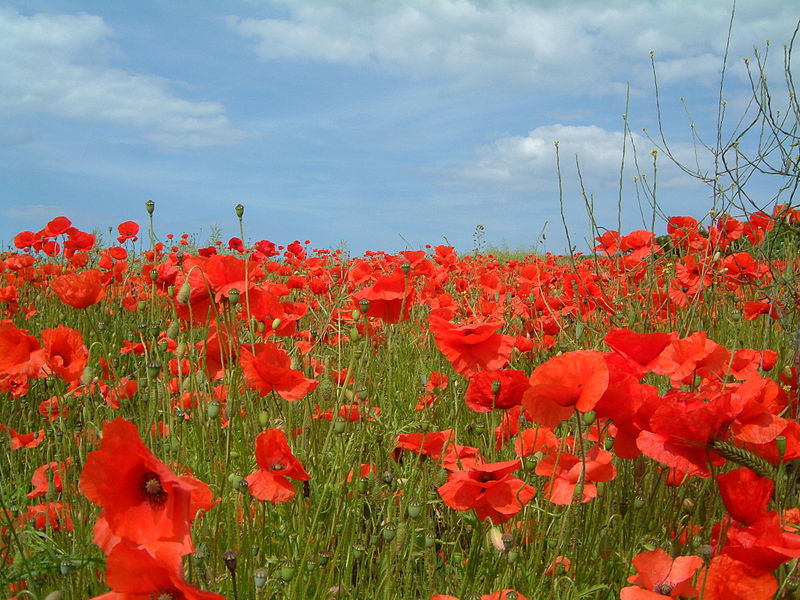
Papaver rhoeas - The Field Poppy


Field Poppy – Papaver rhoeas

The cadmium red Field Poppy, also known as Corn, Flanders or Red Poppy (Papaver rhoeas) is a hardy annual plant that grows wild in fields in parts of Europe such as Great Britain, France and Brussels.  It is also cultivated in gardens and wild flower meadows.
http://upload.wikimedia.org/wikipedia/commons/thumb/a/a0/Poppy2004.JPG/800px-Poppy2004.JPG

The field poppy has been a popular flower throughout history. Dried field poppies have been found in the tombs of ancient Egyptian princesses.  Their fleeting beauty has been immortalized in paintings by Claude Monet, Robert William Vonnoh and other Impressionists, Odilon Redon, Vincent van Gogh, and Georgia O’Keefe among many others. (I created a board on Pinterest to gather copies of these paintings together into one location.)

The Field Poppy became a symbol of remembrance in 1918 for the soldiers who fought and died in World War I. Inspired by the poem “In Flanders Fields”, American Moina Michael began wearing a red silk poppy to honor those fallen soldiers. She campaigned to have it adopted as a national symbol of remembrance and in 1920 the American Legion did just that. This symbol was also adopted by the Commonwealth Nations of Great Britain, Canada, Australia and New Zealand. Red paper poppy flowers are sold and worn on Memorial and Veteran’s Days in the United States and on Poppy and Remembrance Days in Great Britain. 

As their common name might suggest, Field Poppies are easy to grow. Select a sunny location with well drained soil. Loosen the ground and scatter the seeds evenly over it. This is best accomplished by mixing the miniscule seeds with sand. The seeds can be purchased from some suppliers with a coating that makes them larger and easier to sow.  Water regularly and remove any competing weeds. Sow the seeds in late autumn or early spring as they are cold hardy and sprout as soon as the soil warms up. Remove the flowers and stems as they fade to encourage new flower buds. This will extend the bloom time from late June into August. At that time allow the flowers to go to seed and scatter onto the ground. Follow this routine and you will have poppies year after year.

Besides the brilliant shades of red – from cadmium to scarlet to crimson – hybrids such as the Shirley Poppies will provide a range of colors from pale to deep pinks, apricots, creams, mauves and whites that do not have the characteristic black centers.

The Field Poppy, like all poppies, produces a milky white sap, called latex. Unlike its relative, Opium Poppy (P. somniferum), this sap does not contain opium. It does contain rhoeadine which has been used as a sedative. The seeds are sometimes used in baking as a substitute for bread poppy. The flower petals have also been used as a wrinkle preventer as well as a dye for wines, medicines and inks. The oil from the seeds is used as a medium for oil painting.
http://upload.wikimedia.org/wikipedia/commons/f/ff/Poster_papaver_3a.jpg


Though the flowers last a few short days, it is a joy to watch these plants grow. First putting forth nodding buds on thin, wiry stems that open to brilliant color, they eventually transform into ornamental seedpods. These can be cut and used in dried floral arrangements and wreaths along with the seed heads of other wildflowers. A perfect autumn centerpiece.

Article written by Susan Ernst for 12 Months in View.

Thursday, October 3, 2013

Cow Parsley and Wild Carrot


Cow Parsley, Anthriscus sylvestris

Neath billowing skies that scatter and amass.
All round our nest, far as the eye can pass,
Are golden kingcup-fields with silver edge
where the cow-parsley skirts the hawthorn-hedge.
'Tis visible silence, still as the hour-glass.


Dante Gabriel Rossetti, (1828-1882).

Anthriscus sylvestris, commonly known as Cow Parsley, Wild Chervil, Hedge Parsley, Queen Anne’s Lace, and Devil’s Parsley, is a common wildflower of the English countryside and is largely naturalized throughout the United States and Canada, primarily in the Northeast. It is considered a noxious weed in 46 states in the United States.

 Cow Parsley is a member of the carrot family, Apiaceeae, and shares many physical characteristics with its relatives Wild Carrot, Daucus carota, (commonly known as Queen Anne’s Lace in the US), Poison Hemlock, Conium maculatum, and Fool’s Parsley, Aethusa cynapium.  All of these have white umbel flowers and fern like leaves. Queen Anne’s Lace (D. carota), is easily distinguished from the group with its purplish black “eye” in the center of the white flower as well as delicate green bracts at the base of the flower. Its leaves are of a finer texture than the more coarse Cow Parsley. In autumn, Queen Anne’s Lace is easily spotted in a field by its inverted seed heads which resemble birds’ nests. Cow Parsley and its poisonous cousins maintain the umbel shape as it displays its seeds.

 Though once included in the diets of the Celts, all sources advise against collecting and using this plant for food, medicine or dye. Other plants are better suited for those purposes and are not easy to confuse with poisonous plants.

Enjoy the Cow Parsley you find growing in abandoned fields and along highways and country roads, but let it be. Collect (with permission) the Queen Anne’s Lace or Wild Carrot flowers for fresh bouquets in spring, and the seed heads for dried bouquets in autumn.

Article written by Susan Ernst for 12 Months in View