Tuesday, November 12, 2013

Monthly Garden Photos - November 2013

It is interesting that it is already November 12 and we have not had a frost. We usually get one the third week of October. The weather has been very dry. We haven't gotten any rain for about five weeks. A lack of moisture in the air may be the reason for the lack of a frost. It has been delightful to have flowers still in bloom and even reblooming. There is one yellow iris plant that has a big beautiful bud on it. Ready to open any day if the weather holds up. But after today, I don't think it will.
 Here are the monthly photos for November plus a few more.

The Perennial Garden

The Enclosed Garden

Garden outside Wisteria Studio
The Family Pond and Wetlands


Sunday, November 3, 2013

Cicely Mary Barker's Poppy Fairy

The Poppy Fairy
http://lowres-picturecabinet.com.s3-eu-west-1.amazonaws.com/68/main/1/228836.jpg
Why this post? Read here.

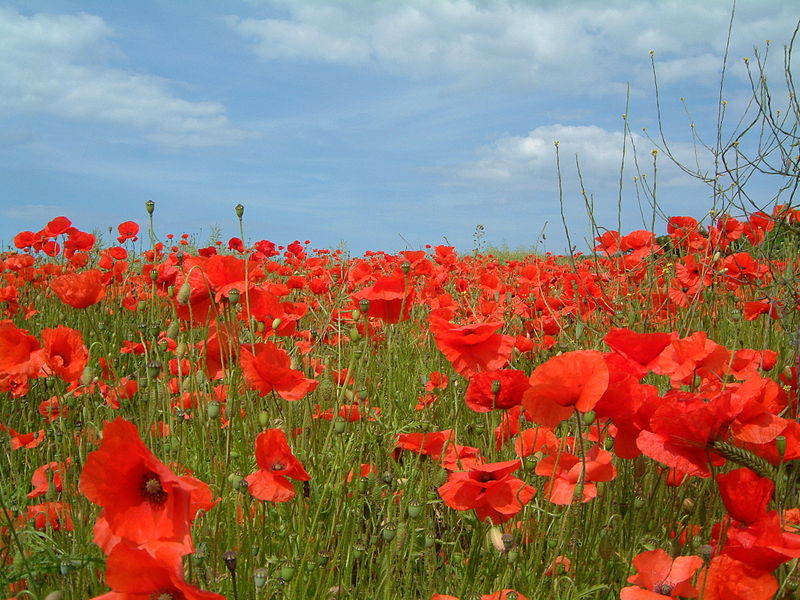
Papaver rhoeas - The Field Poppy


Field Poppy – Papaver rhoeas

The cadmium red Field Poppy, also known as Corn, Flanders or Red Poppy (Papaver rhoeas) is a hardy annual plant that grows wild in fields in parts of Europe such as Great Britain, France and Brussels.  It is also cultivated in gardens and wild flower meadows.
http://upload.wikimedia.org/wikipedia/commons/thumb/a/a0/Poppy2004.JPG/800px-Poppy2004.JPG

The field poppy has been a popular flower throughout history. Dried field poppies have been found in the tombs of ancient Egyptian princesses.  Their fleeting beauty has been immortalized in paintings by Claude Monet, Robert William Vonnoh and other Impressionists, Odilon Redon, Vincent van Gogh, and Georgia O’Keefe among many others. (I created a board on Pinterest to gather copies of these paintings together into one location.)

The Field Poppy became a symbol of remembrance in 1918 for the soldiers who fought and died in World War I. Inspired by the poem “In Flanders Fields”, American Moina Michael began wearing a red silk poppy to honor those fallen soldiers. She campaigned to have it adopted as a national symbol of remembrance and in 1920 the American Legion did just that. This symbol was also adopted by the Commonwealth Nations of Great Britain, Canada, Australia and New Zealand. Red paper poppy flowers are sold and worn on Memorial and Veteran’s Days in the United States and on Poppy and Remembrance Days in Great Britain. 

As their common name might suggest, Field Poppies are easy to grow. Select a sunny location with well drained soil. Loosen the ground and scatter the seeds evenly over it. This is best accomplished by mixing the miniscule seeds with sand. The seeds can be purchased from some suppliers with a coating that makes them larger and easier to sow.  Water regularly and remove any competing weeds. Sow the seeds in late autumn or early spring as they are cold hardy and sprout as soon as the soil warms up. Remove the flowers and stems as they fade to encourage new flower buds. This will extend the bloom time from late June into August. At that time allow the flowers to go to seed and scatter onto the ground. Follow this routine and you will have poppies year after year.

Besides the brilliant shades of red – from cadmium to scarlet to crimson – hybrids such as the Shirley Poppies will provide a range of colors from pale to deep pinks, apricots, creams, mauves and whites that do not have the characteristic black centers.

The Field Poppy, like all poppies, produces a milky white sap, called latex. Unlike its relative, Opium Poppy (P. somniferum), this sap does not contain opium. It does contain rhoeadine which has been used as a sedative. The seeds are sometimes used in baking as a substitute for bread poppy. The flower petals have also been used as a wrinkle preventer as well as a dye for wines, medicines and inks. The oil from the seeds is used as a medium for oil painting.
http://upload.wikimedia.org/wikipedia/commons/f/ff/Poster_papaver_3a.jpg


Though the flowers last a few short days, it is a joy to watch these plants grow. First putting forth nodding buds on thin, wiry stems that open to brilliant color, they eventually transform into ornamental seedpods. These can be cut and used in dried floral arrangements and wreaths along with the seed heads of other wildflowers. A perfect autumn centerpiece.

Article written by Susan Ernst for 12 Months in View.

Thursday, October 3, 2013

Cow Parsley and Wild Carrot


Cow Parsley, Anthriscus sylvestris

Neath billowing skies that scatter and amass.
All round our nest, far as the eye can pass,
Are golden kingcup-fields with silver edge
where the cow-parsley skirts the hawthorn-hedge.
'Tis visible silence, still as the hour-glass.


Dante Gabriel Rossetti, (1828-1882).

Anthriscus sylvestris, commonly known as Cow Parsley, Wild Chervil, Hedge Parsley, Queen Anne’s Lace, and Devil’s Parsley, is a common wildflower of the English countryside and is largely naturalized throughout the United States and Canada, primarily in the Northeast. It is considered a noxious weed in 46 states in the United States.

 Cow Parsley is a member of the carrot family, Apiaceeae, and shares many physical characteristics with its relatives Wild Carrot, Daucus carota, (commonly known as Queen Anne’s Lace in the US), Poison Hemlock, Conium maculatum, and Fool’s Parsley, Aethusa cynapium.  All of these have white umbel flowers and fern like leaves. Queen Anne’s Lace (D. carota), is easily distinguished from the group with its purplish black “eye” in the center of the white flower as well as delicate green bracts at the base of the flower. Its leaves are of a finer texture than the more coarse Cow Parsley. In autumn, Queen Anne’s Lace is easily spotted in a field by its inverted seed heads which resemble birds’ nests. Cow Parsley and its poisonous cousins maintain the umbel shape as it displays its seeds.

 Though once included in the diets of the Celts, all sources advise against collecting and using this plant for food, medicine or dye. Other plants are better suited for those purposes and are not easy to confuse with poisonous plants.

Enjoy the Cow Parsley you find growing in abandoned fields and along highways and country roads, but let it be. Collect (with permission) the Queen Anne’s Lace or Wild Carrot flowers for fresh bouquets in spring, and the seed heads for dried bouquets in autumn.

Article written by Susan Ernst for 12 Months in View

Saturday, September 14, 2013

Practicing the Art of Being Fully Present

In July my husband and I stayed overnight in a luxurious bed and breakfast in Durham, NC. It is too bad we were there for only one night. It really is a place to go to spend a few relaxing days. After breakfast we walked around the gardens before heading on our way. I was reminded of our honeymoon. We drove up to Nova Scotia and stayed in bed and breakfasts and country inns. I found that to be a delightful experience. Since that time, which was 27 years ago, Bob and I often discussed owning a b&b in the country some day. Back home from the trip and tending to our gardens, I began thinking about how I could make that dream a reality today. No, it isn't practical to turn our tiny house into a b&b, but what could I do to invite people to enjoy the peace and beauty that I experience while spending time in my gardens?

I was also reading a book called An Altar in the World by Barbara Brown Taylor at this time. I found it extremely inspirational and life changing. Chapter Two, entitled The Practice of Paying Attention is what helped me to formulate the retreat. (The seeds of which had already been planted last year while reading The Artist's Rule by Christine Valters Paintner, which is along a similar vein.) I realized that I didn't need a fancy house and immaculate gardens in order to help others see and hear what I do when I am outside. If I love it, won't others as well? I took the chance and offered this one day retreat.
Yesterday, six wonderful women enjoyed their time here. They got to relax, reflect and spend some needed alone time. We did end the day with sharing. It was moving to hear what these women were able to experience from the assignments they were given and the time they spent alone in nature.

 I plan to hold this retreat on a monthly basis from May through September. The women encouraged me to add other themed retreats as they would like to participate again. Follow this link to view some of their comments here.

Tuesday, September 3, 2013

Cicely Mary Barker's Hawthorne Fairy

The Hawthorne Fairy
http://lowres-picturecabinet.com.s3-eu-west-1.amazonaws.com/68/main/1/228788.jpg


Why this post? Read here.

Hawthorne


Hawthorn – Crataegus species 

http://upload.wikimedia.org/wikipedia/commons/d/da/110_Crataegus_oxyacantha_L.jpg

Hawthorn, May Blossom or May Tree is a member of the Rose family and contains over one thousand species found in England, Europe, Asia and North America. A small tree, it grows 20-30 ( 10 m) feet tall and wide. Small white flowers borne in clusters (properly termed corymbs) are said to smell foul until pollinated by the flies that are attracted to them. Once the flower is fertilized, the scent becomes a pleasant one. The tree flowers in May; hence it’s alternate common names. Deep green lobed leaves in spring and summer turn beautiful shades of scarlet and orange in autumn. Haws, as the fruit is called, ripen in September and October. The fruit is similar in appearance to the hips of wild roses.

Haws are a favorite food of birds and small animals and have been used by humans. The ripe fruit is gathered and used to make a preserve (with lemons and sugar) or cooked with other fruits to make jellies, as they are rich in pectin. This plant has been used to treat arthritis and rheumatism as well as emotional stress, nervous and heart conditions. Native Americans dried the berries, then ground them into meal and mixed with wheat or corn flour for baking. They also turned the bark fibers into cordage and used the thorns as awls.

Another name for this tree was Fairy Thorn. Named by the ancient Bretons, they believed that the tree was haunted by fairies. English Hawthorn, Crataegus monogyna or C. oxycantha, was planted extensively as a hedgerow plant because of its quick growth and long thorns. The word “hedge” is in fact derived from the Anglo-Saxon word for hawthorn – Haegthorn.  According to one author, Frank Tozer, ancient hedgerows are becoming a thing of the past in England. He writes, “In densely populated Britain, Hawthorn hedges were very important to wildlife, as a source of both food and habitat. Indeed much of the wildlife in that country has disappeared in the past forty years, as hedgerows have been torn out to enlarge farm fields for mechanized farming. Another negative effect of their removal has been vastly increased soil erosion.” Hawthorns spread by suckers which can be a nuisance if planted in a small area, but does help to keep soil in place.

There are several hawthorn species native to the United States. These are usually found growing along the edges of forests or meadows. Presidents George Washington and Thomas Jefferson planted Crataegus phaenopyrum on their estates.

In the Language of Flowers, Hawthorn symbolizes hope, marriage and fertility. A plant rich in English folklore, the ship which carried English pilgrims to the New World was named The Mayflower, after this plant. A pretty comprehensive survey can be found here:


Article written by Susan Ernst for 12 Months in View.